


I wasn’t diagnosed as dyslexic until I was 21 years of age.
It wasn’t picked up at school. Like many people of my generation, I simply went through the education system struggling with certain things without really knowing why.
I wouldn’t say that I was necessarily told I was stupid. But there were certainly times when you were made to feel that way.
At one stage, I remember being made to sit at a special table at the front of the classroom with two or three other pupils who were struggling.
I’m sure the intention was to help us.
But when you’re a child, sitting at the “special table” doesn’t necessarily feel like help. It feels like everyone else knows you’re one of the ones who can’t keep up.
And that can stay with you.
When struggling becomes learned behaviour
One of the things I’ve thought about over the years is what repeated failure does to you.
If you find something difficult, try it, and continually don’t succeed, eventually there’s a danger that you learn there’s no point in trying.
That’s particularly damaging for someone with dyslexia because dyslexia is not a measure of intelligence.
Today, that’s much better understood. Dyslexia is recognised as a learning difference that primarily affects skills involved in reading, writing and spelling. It has no direct relationship with IQ.
But knowing that now and understanding it as a child are two very different things.
I did have some very good teachers who recognised that there was more going on.
A couple of them used to say:
“If only Michael could talk his exams, he would fly through them.”
And they were probably right.
Take subjects like history or geography. You might know the subject. You might understand exactly what happened, why it happened and be perfectly capable of explaining it in conversation.
But in an exam, you’re not just being tested on your knowledge.
You’re also being tested on your ability to get that knowledge onto a piece of paper — to structure it, write it and spell it correctly.
For someone with dyslexia, those can be two very different tests.
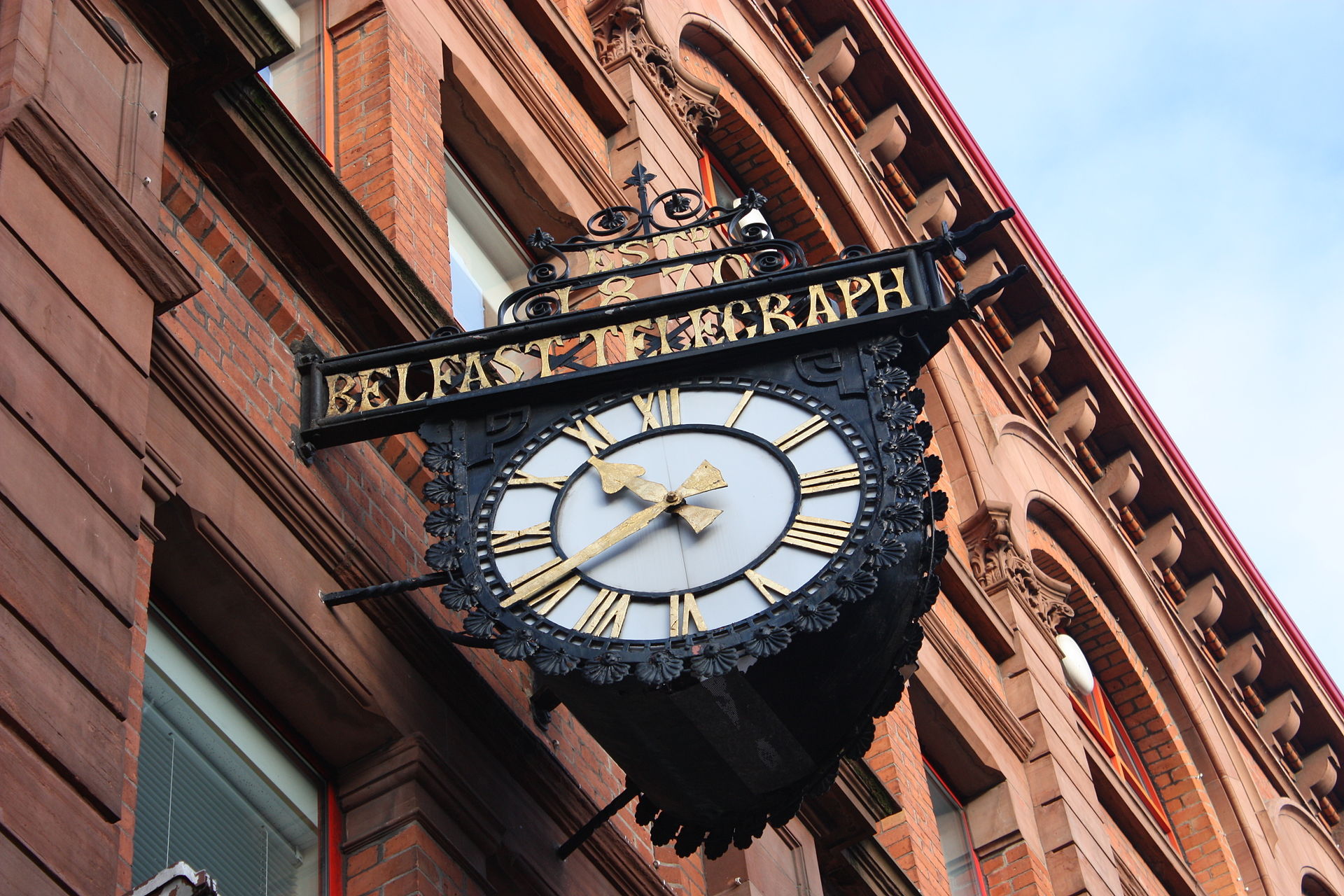
Welcome to the Belfast Telegraph
In my early twenties, I went to work for the Belfast Telegraph selling advertising.
Initially, I worked on what was called the front counter.
People would walk in with their bits of paper to place classified advertisements, which in those days were charged at “tuppence a word”.
And this was Belfast during the Troubles.
From time to time, some fairly rough-looking gentlemen would arrive to place a death notice for a comrade who had been shot the previous day, sometimes complete with a tagline such as “killed by the enemies of Ulster”.
Getting the spelling wrong wasn’t really something you wanted to contemplate.
Eventually I moved into the main Belfast Telegraph building and worked in telesales.
(It’s also where I met my wife, but that’s another story).
I was taking telephone calls from people placing advertisements into the newspaper. Sometimes these were death notices that had to appear in that evening’s paper.
For someone whose spelling was horrendous, this was terrifying.
Everything I typed would come off on a printer, and I’d wear out the patience of the copy checkers, asking them to run their eye over everything I’d written. In my mind, there was bound to be a mistake somewhere!
The little book I’ve never forgotten
My managers manager at the time was a woman called Margaret Clarke.
Mrs Clarke, as she was known, obviously realised that I was struggling with certain elements of the job.
Instead of making an issue of it, she did something incredibly kind.
She put together a little reference book for me containing the most commonly used words and terms across the different newspaper classifications.
It must have taken her quite a bit of time.
I kept that little book beside me and used it whenever I was taking calls.
Looking back, it was such a simple thing. But it made an enormous difference.
Sometimes helping someone isn’t about lowering expectations. It’s about giving them the tools they need to meet them.
The dyslexic who made the fewest mistakes
Later, I moved into field sales and for several years worked for The Yellow Pages.
That presented another challenge.
There was a huge amount of writing involved, and tasks that other Yellow Pages reps could get through fairly quickly often took me twice as long, simply because I had to check and recheck everything. But then something rather ironic happened.
Every year there was an award for what was called the “fewest rejects”.
Basically, advertisements were sent through for production and could be rejected because of spelling errors or other mistakes.
I ended up having the fewest mistakes in the whole country.
The dyslexic won the award for making the fewest mistakes.
There was a very simple reason. I checked absolutely everything.
Then I checked it again. And quite often I checked it a third time.
Something that had started as a coping mechanism had actually become a strength.
Hiding it
For many years, I probably hid my dyslexia. I certainly didn’t go around telling people about it.
Why? Probably a little bit of embarrassment. Probably a fear that people would judge me. And probably a concern that if somebody knew I was dyslexic, they might think differently about my intelligence or my ability to do the job.
As I’ve got older, I’ve become much less concerned about that.
I’m perfectly comfortable saying to someone now:
“Look, I’m dyslexic. This particular thing is a bit of a challenge for me.”
Thankfully, people generally understand it much better today, and frankly, I’m now at the age that I dont really care.
The term dyslexia itself has been around since the late 19th century. Early researchers described some children who were otherwise clearly intelligent but had significant difficulty learning to read. Over the following century, our understanding developed considerably.
Today we know that dyslexia occurs across the full range of intellectual abilities.
In other words, being dyslexic doesn’t mean you’re stupid. It never did.
Even spellcheck has its limits
Technology has obviously made things easier.
When spellcheck arrived on computers, it was fantastic.
But there’s a slight problem with spellcheck when you’re dyslexic.
You have to get close enough to the word in the first place for the computer to have some idea what you’re trying to spell.
There are still plenty of occasions when I type a word and spellcheck basically says:
“I’ve got absolutely no idea what you’re trying to do here, Michael.”
So I improvise. I find another word that I can spell which fits the sentence.
And perhaps there’s something in that. Dyslexia forces you to problem-solve.
If the obvious route doesn’t work, you find another one.
Would I change it?
There is another side to all of this.
I’m musical. I write songs. I perform. Music has been an enormous part of my life.
There is plenty of research and discussion around dyslexia, creativity and different ways of thinking. I’m always slightly cautious about calling dyslexia a “superpower”, because for many people it can be a genuine and sometimes frustrating difficulty.
I certainly wouldn’t pretend there haven’t been times when I wished I wasn’t dyslexic.
But if somebody offered me a deal today — I could get rid of the dyslexia, but I’d also have to give up whatever part of my brain allows me to write songs and make music — I wouldn’t even have to think about it.
I’d take the dyslexia all day long.
Because music has given me far more than good spelling ever could.
Finding another way
Looking back, I don’t think dyslexia defines me. But it has undoubtedly shaped me.
It has made certain things harder and slower. It has embarrassed me at times. And, particularly when I was younger, it probably affected my confidence more than I realised. (Anyone who knows me will think that’s bonkers. I could walk into a room full of complete strangers and happily talk to anyone — just don’t hand me a piece of paper and ask me to read it out loud
) But it also taught me to check things carefully, to solve problems, to find another route and, perhaps most importantly, to recognise that intelligence comes in many different forms.
We can be very quick to measure people by the things they struggle with.
Maybe we should spend a little more time looking for the things they’re brilliant at.
And if you happen to spot a spelling mistake in this article?
You know who to blame.
Although, knowing me, I’ve probably checked it three times.